Joyce Jones
Buying a Property in Quebec: Down Payment and Financing Options
24 Sep 2026
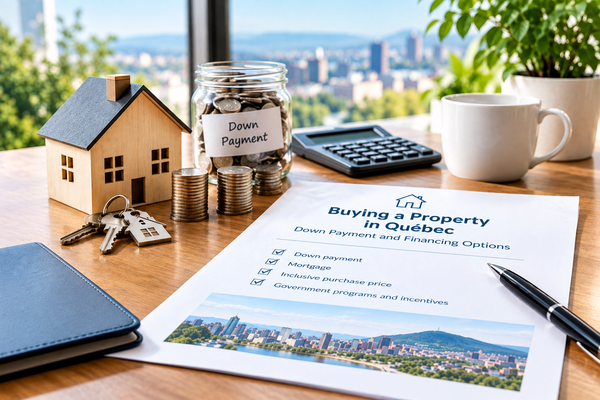
Buying a Property in Quebec: Down Payment and Financing Options
In short: in Canada in 2026, the minimum down payment is 5% up to $500,000, then 10% on the portion above, and 20% from $1.5M. Below 20%, mortgage default insurance (CMHC) applies. On the financing side, you choose between an insured or conventional mortgage, and a fixed or variable rate. Programs like the FHSA and the HBP help build your down payment. Get pre-approved and surround yourself with professionals. (Figures current in 2026 — confirm with your lender.)
Buying a property is likely the biggest investment of your life. Before falling in love with a home, it's best to understand two key elements: how much you need to put down (the down payment) and how you'll finance the rest (the mortgage). Here's what you need to start on the right foot in Quebec.
Please note: the rules and amounts below are current in 2026 and may change. This article is for information only; always confirm your situation with a financial institution or a mortgage broker.
1. The Down Payment: What's the Minimum?
In Canada, the minimum down payment isn't a single percentage. It follows a tiered scale based on the purchase price:
- $500,000 or less: 5% of the price.
- Between $500,000 and $1,499,999: 5% on the first $500,000, then 10% on the portion above.
- $1,500,000 and up: 20% minimum.
In practice, for a $700,000 property, the minimum down payment is $45,000 (5% of $500,000 + 10% of $200,000), not $35,000. For a $1,000,000 property, it's $75,000. Putting down 20% or more avoids mortgage default insurance (see below) and lowers your loan.
2. Mortgage Default Insurance (When Your Down Payment Is Below 20%)
If your down payment is under 20%, the law requires mortgage default insurance (CMHC, Sagen or Canada Guaranty). It protects the lender, not you, and its premium — often between 2.8% and 4.0% of the loan amount — is added to your mortgage. In Quebec, this premium is also subject to provincial sales tax (QST), payable at closing. It's a cost to build into your budget from the start.
3. Insured or Conventional Mortgage?
- An insured mortgage (down payment under 20%) is available for properties under $1.5M — a cap raised from $1M to $1.5M on December 15, 2024.
- A conventional mortgage (down payment of 20% or more) requires no insurance and is mandatory above $1.5M.
For amortization (the total time to repay), an insured mortgage usually runs 25 years. Since December 2024, first-time buyers and buyers of a newly built home can access a 30-year amortization, which lowers monthly payments.
4. Fixed or Variable Rate, Term and Amortization
Two concepts not to confuse: the term is the length of your contract with the lender (often 3 to 5 years), while the amortization is the total time to repay everything (25 or 30 years).
As for the rate:
- A fixed rate doesn't change during the term: predictable payments, peace of mind.
- A variable rate follows market rates: potentially cheaper, but with a risk of rising payments.
Whichever you choose, you'll need to pass the stress test: you must qualify at the higher of your rate + 2% or 5.25%. One more reason to get pre-approved before you start shopping.
5. Programs That Help Build Your Down Payment
Several measures, available in Quebec, ease the savings effort — especially for a first home:
- The FHSA (First Home Savings Account): up to $40,000 lifetime, with tax-deductible contributions and tax-free withdrawals for the purchase.
- The HBP (Home Buyers' Plan): a withdrawal from your RRSP of up to $60,000 per person, repaid over 15 years.
- The Home Buyers' Tax Credit: about $1,500.
- The GST/QST rebate for a newly built home, if you qualify.
Good to know: lenders accept various sources for the down payment — personal savings, FHSA, HBP and a gift from an immediate family member — but they will verify where the funds come from.
6. Other Costs to Plan For (Beyond the Down Payment)
Your budget isn't limited to the down payment. Also plan for notary fees, the welcome tax (transfer duties), the pre-purchase inspection, tax adjustments with the seller, home insurance and moving. These amounts, due at closing or shortly after, are worth estimating early.
7. Get Pre-Approved and Surround Yourself With Professionals
A mortgage pre-approval gives you a clear budget and a strong position with sellers — an advantage in a competitive market. For the rest, a good team makes the difference: a real estate broker to find and negotiate the right property, a mortgage broker or advisor to optimize your financing, and a notary to secure the transaction. Well supported, you buy with confidence.
Frequently Asked Questions
What's the minimum down payment in Quebec in 2026? 5% up to $500,000, then 10% on the portion above, and 20% from $1.5M. For a $700,000 property, that's $45,000.
What is mortgage default insurance and when does it apply? It's mandatory when the down payment is under 20%. Its premium is added to the mortgage, and in Quebec it's subject to QST, payable at closing.
Is a fixed or variable rate better? Fixed offers predictable payments; variable can cost less but carries a risk of increases. The right choice depends on your risk tolerance and the market context.
Can the FHSA and HBP be combined? Yes. Many first-time buyers use both to maximize their down payment. Confirm the amounts and conditions that apply to your situation.
Should I get pre-approved before viewing properties? It's strongly recommended: you'll know your real budget and can make stronger offers.
Ready to Make Your Purchase Happen?
Thinking of buying? Joyce Jones, residential and commercial real estate broker at Via Capitale Parcours, guides you from house-hunting all the way to signing at the notary. Check out the Buyer's Guide and start finding a property today.
📞 514 929-0861 · ✉️ jojones@live.ca